
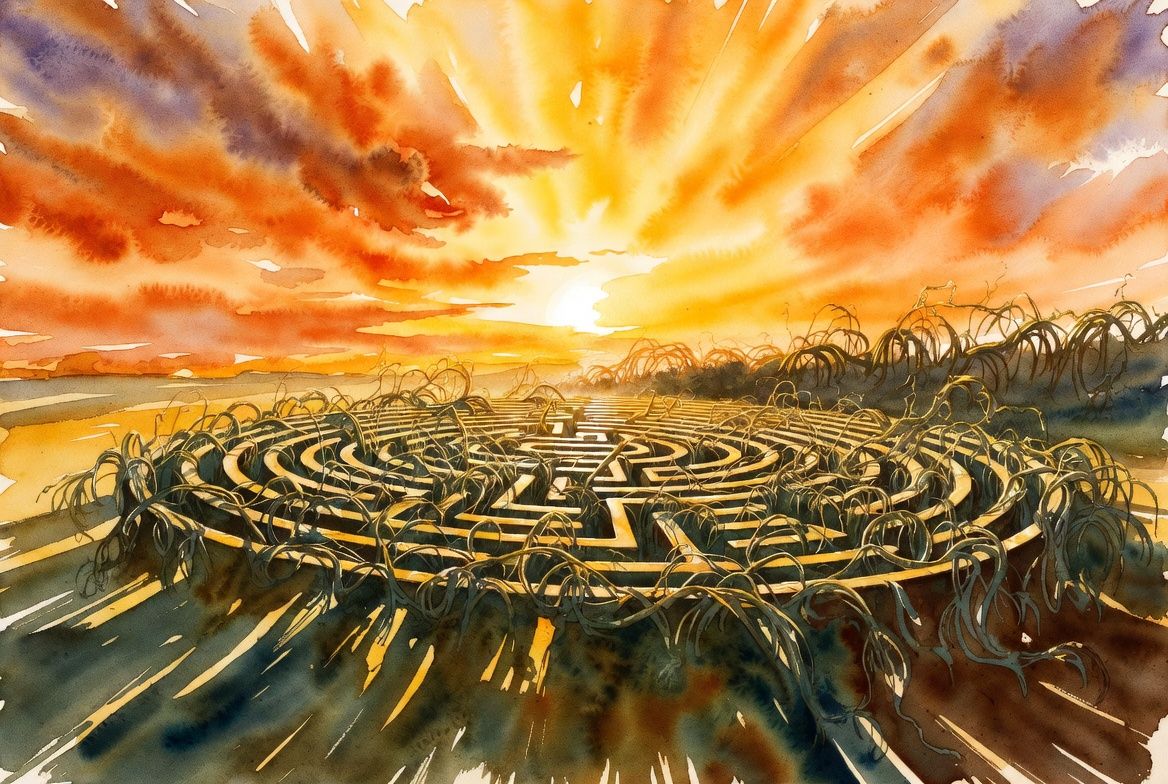

The Empty Search Result That Says Everything
You search for the architecture of human fulfillment, and the algorithm returns an instruction manual for reading text files. That’s exactly what happened when we went looking for hard data on how people find their «why»: the digital excavation produced technical documentation for Jina AI Reader and nothing else. No case studies. No longitudinal happiness research. No Victor Frankl. Just mechanics.
This silence is louder than it appears.
We have built machines that can parse every word ever written, yet when asked where meaning comes from, they offer us tools for processing syntax. The vacuum itself tells a story about the nature of purpose—it resists extraction, aggregation, and optimization. Meaning isn’t data. It is the answer to a question only you can ask.
While the retrieved documents contained no实证 guidance on purpose-driven living, decades of psychology and philosophy have illuminated what the servers couldn’t cache: lasting happiness and purpose are not twins. They are different species of satisfaction entirely.
The Great Divorce: Feeling Good vs. Being Good
Happiness is a weather pattern. Purpose is climate.
Researchers in positive psychology—most notably Martin Seligman and his contemporaries—have drawn a sharp line between hedonic well-being (pleasure, enjoyment, the absence of pain) and eudaimonic well-being (meaning, growth, contribution). You can have one without the other. A life of constant pleasure can feel empty; a life of deep purpose can be painful.
Consider the careworn emergency room physician working through her third consecutive night shift. She is not happy. She is exhausted, stressed, and witnessing suffering. But she is fulfilled. The stress is load-bearing—it carries meaning. Contrast this with the lottery winner who spends six months on a yacht before spiraling into anhedonia. His hedonic dashboard reads full; his eudaimonic account is overdrawn.
Purpose acts as a shock absorber. Studies consistently show that people with a strong sense of meaning—not just high positive affect—are more resilient to trauma, physical pain, and the ordinary attrition of aging. The data suggests your «why» doesn’t just make life worth living; it makes life survivable.
Where Purpose Actually Lives
Viktor Frankl, writing from the abyss of Nazi concentration camps, observed that those who survived weren’t necessarily the strongest or youngest, but those who saw meaning in their suffering—whether unfinished work, love waiting beyond the wire, or spiritual duty. Meaning, Frankl argued, isn’t discovered like a vein of ore. It is assigned like a mission.
Contemporary research bears this out. Purpose is rarely found in the abstract. It emerges from three specific tributaries:
1. The Transcendent
Serving something larger than the self—whether God, community, a political cause, or the protection of a species. The «why» here is external and eternal.
2. The Creative
Building, making, organizing, or solving. The craftsperson, the inventor, the parent shaping a child. Purpose here is generative; you are the bridge between what is and what could be.
3. The Relational
The radical choice to be irreplaceable to someone else. Not networking. Not popularity. The heavy commitment to another human’s dignity.
Notice what is absent from this list: self-actualization. The modern obsession with «finding yourself» often leads away from meaning because it treats the self as the object of the search. But purpose is a vector, not a possession. It points outward.
The Algorithm Cannot Find It For You
The irony of our initial failed search is profound. We asked a machine to read documents about human purpose and it only taught us how to read documents. This mirrors the error we make in our own lives: treating meaning as content to be consumed rather than a direction to be chosen.
You do not stumble upon your why while scrolling. You construct it through action and consequence. A barista who sees her work as «serving coffee» will burn out. The same barista who sees her work as «providing the one moment of warmth in a customer’s hostile morning» has built a cathedral from the same ingredients. The difference is narrative architecture, not job description.
Psychologists call this «mattering»—the subjective perception that one’s existence is significant to others. It is manufactured, not mined. You claim purpose by betting on your values with your time, even before the feeling of certainty arrives. Especially before it arrives.
The Durability Test
Here is the final metric, untainted by the documents we failed to find: happiness dissipates when you check your bank account. Purpose persists when you lose the account entirely.
When researchers follow subjects over decades, the correlation between wealth and life satisfaction is modest and plateaus quickly. The correlation between purpose and longevity, however, is robust. People with a clear sense of meaning have lower cortisol levels, less cardiovascular disease, and slower cognitive decline. Your «why» is biological insurance.
So while the servers offered us only technical specifications, the human record offers something richer. Purpose is not a feeling that visits you. It is a prison you build to contain your chaos, a debt you choose to owe the future, a refusal to be interchangeable.
The search result was empty because the answer can never be archived. It can only be enacted.



