
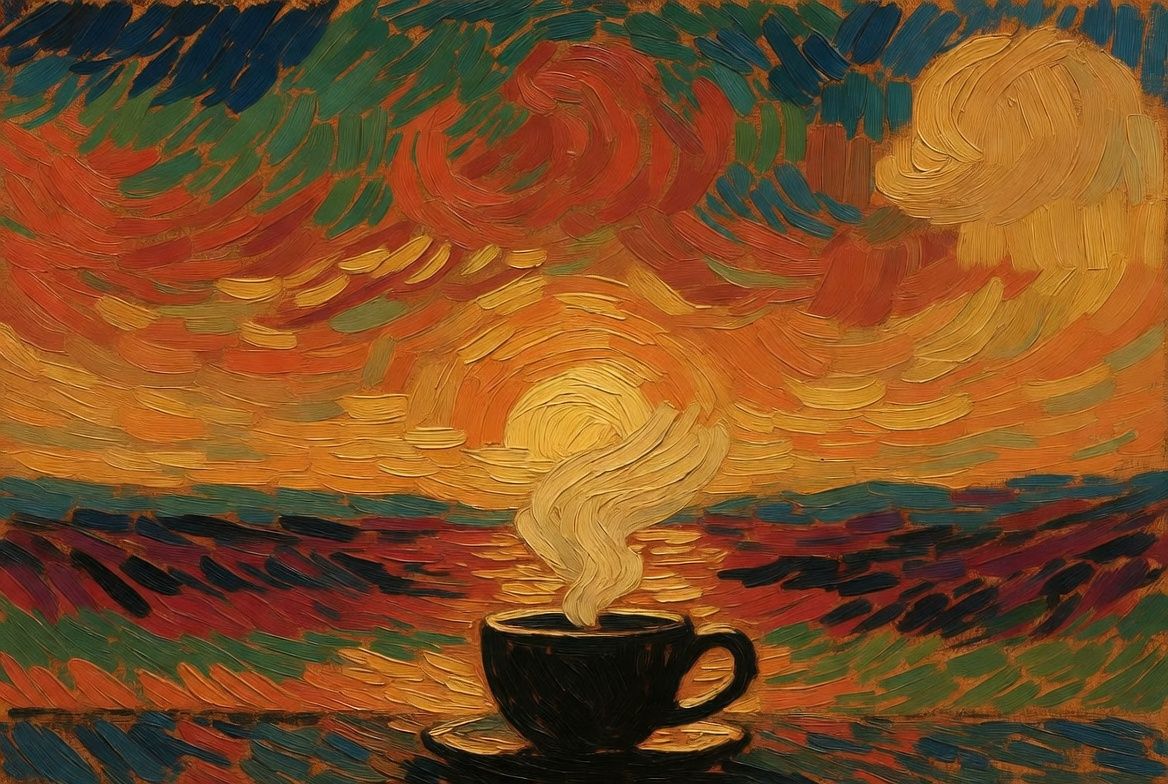

The Centenarian Who Just Likes His Coffee
In the blue zones of Okinawa, where more people live past one hundred than anywhere else on earth, researchers kept asking the same question: what keeps you getting out of bed in the morning? One fisherman said it was his morning tea with neighbors. A ninety-eight-year-old grandmother pointed to her great-granddaughter’s drawings taped to the refrigerator. Not a single one pulled out a four-circle Venn diagram or used the word «passion» as a verb.
Yet in the West, Ikigai has been shrink-wrapped into precisely that: a quarterly planning tool for the hyper-ambitious. Search the term online and you’ll find a pastel infographic suggesting that purpose sits at the intersection of what you love, what you’re good at, what the world needs, and—crucially—what you can be paid for. The implication is tidy. Find the overlap, quit your job, and voilà: fulfillment arrives like a direct deposit.
But that’s only half the story. If not less.
The Venn Diagram That Lied to You
The popular visual model—four overlapping circles creating a perfect center—bears about as much relationship to traditional Japanese conceptions of Ikigai as a corporate mission statement bears to actual meaning. Anthropologists who study Okinawan culture note that the term traditionally requires no career component whatsoever. Your Ikigai might be digging in your garden, listening to a friend’s troubles, or simply maintaining the ritual of a slow breakfast. It is less about scaling your personal brand and more about feeling the texture of being alive.
This is where it gets interesting. The Japanese framework identified in the research describes four elements—Naitō (passion), Nijō (mission), San’ya (vocation), and Shokugō (profession)—but treats them as currents in a river, not checkboxes in a business plan. You do not need all four to collide in a perfect center. A hospice nurse might find her Ikigai in the vocation of caregiving while accepting that the pay is insufficient and the emotional toll contradicts «passion» as we typically understand it. An amateur cellist might possess no professional standing whatsoever, yet decades of playing for no audience creates a purpose that anchors his entire existence.
The research presents a critical contradiction here: some interpretations demand career alignment, while others insist that Ikigai thrives specifically in the unpaid, unacknowledged corners of life. The data refuses to resolve this debate, and perhaps that is the point.
When Your Reason for Being Pays Nothing
Here is a gap that deserves scrutiny. Despite the volumes written about Ikigai, no consensus exists on whether «purpose» requires financial viability. Can unpaid caregiving be a Ikigai? What about political activism that ruins your resume, or art that will never sell?
The research suggests we treat this uncertainty not as a flaw in the framework, but as a feature of being human. The insistence that purpose must be monetized may itself be a cultural artifact—specifically, the American obsession with optimizing every hour for extractable value. In this light, the Western «career-ification» of Ikigai looks less like wisdom and more like a desperate attempt to justify leisure by rebranding it as side-hustle potential.
But let us not swing too far the other way. The research acknowledges Shokugō—sustainable livelihood—as a legitimate component. Starving for your art is not inherently noble; it is merely unsustainable. The tension between vocation and profession creates a productive friction. The trick lies in not letting the necessity of rent conflate your entire identity with your W-2.
How to Actually Hunt for It
If Ikigai is not a destination you arrive at, but a direction you walk, how do you start moving? The research offers four investigative tactics, though they require patience incompatible with influencer culture.
First, conduct forensic analysis on your own joy—not the dopamine hits of scrolling or spending, but the moments when you lose track of time and self-consciousness. The prompt is simple: What activities energize me rather than deplete me? Journaling helps, but only if you resist the urge to monetize the answers immediately.
Second, gather external intelligence. We are spectacularly bad at identifying our own strengths, usually because they feel too easy to us. Ask trusted observers: what problems do I solve without trying? What do you count on me for? This feedback reveals Nijō—your mission—through the eyes of those already benefiting from your existence.
Third, run small experiments. Before quitting your job to become a landscape architect, try volunteering at a local park for three months. The research emphasizes experimentation—side projects, skill swaps, volunteer roles—because Ikigai reveals itself through motion, not meditation.
Finally, and most critically, integrate daily. The research stresses that Ikigai is dynamic, not static. It evolves as your body ages, as parents die, as children leave, as pandemics reshape what you thought was non-negotiable. This means building rituals—morning walks, evening phone calls, weekly acts of service—that create meaning in the granular texture of Tuesday afternoons, not just in mountaintop revelations.
The Cultural Warning Label
We must acknowledge the limitations. Ikigai emerged from a specific cultural context—one with strong community bonds, different expectations of individualism, and a relationship to work that predates the gig economy. Applying it to a single mother working three jobs, or to someone battling clinical depression, requires more humility than most self-help gurus display.
The research explicitly cautions against rigid attachment to any fixed «purpose.» Meaning is permitted to be fluid, contradictory, and multifaceted. Your Ikigai at twenty-five may involve revolution; at sixty-five, it may involve maintenance and repair. Neither is failure.
There is also, notably, no validated measurement tool for Ikigai across diverse demographics. We cannot tell you with scientific precision whether you have found yours. We can only observe the correlates: the Okinawan fisherman outliving the retirement planner; the grandmother who keeps waking up not because she has projects, but because she has people.
Live the Questions
So where does this leave you? Not with a blueprint, certainly. Perhaps with a slightly uncomfortable permission slip to stop searching for the One True Calling and start noticing what already makes you feel necessary to the world, whether or not it appears on a business card.
The research ends without resolution, and so shall we. Your Ikigai might be teaching children, or it might be tending a graveyard shift with precision and dignity. It might vanish next year and reappear as something embarrassingly small—feeding the cat, fixing a neighbor’s sink, watching the steam rise from coffee exactly once every morning.
Stop asking what you were born to do. Start asking what makes tomorrow feel worth the trouble. Then do that again.



