

The Laptop in the Bedroom: How Remote Work Swallowed the Margins
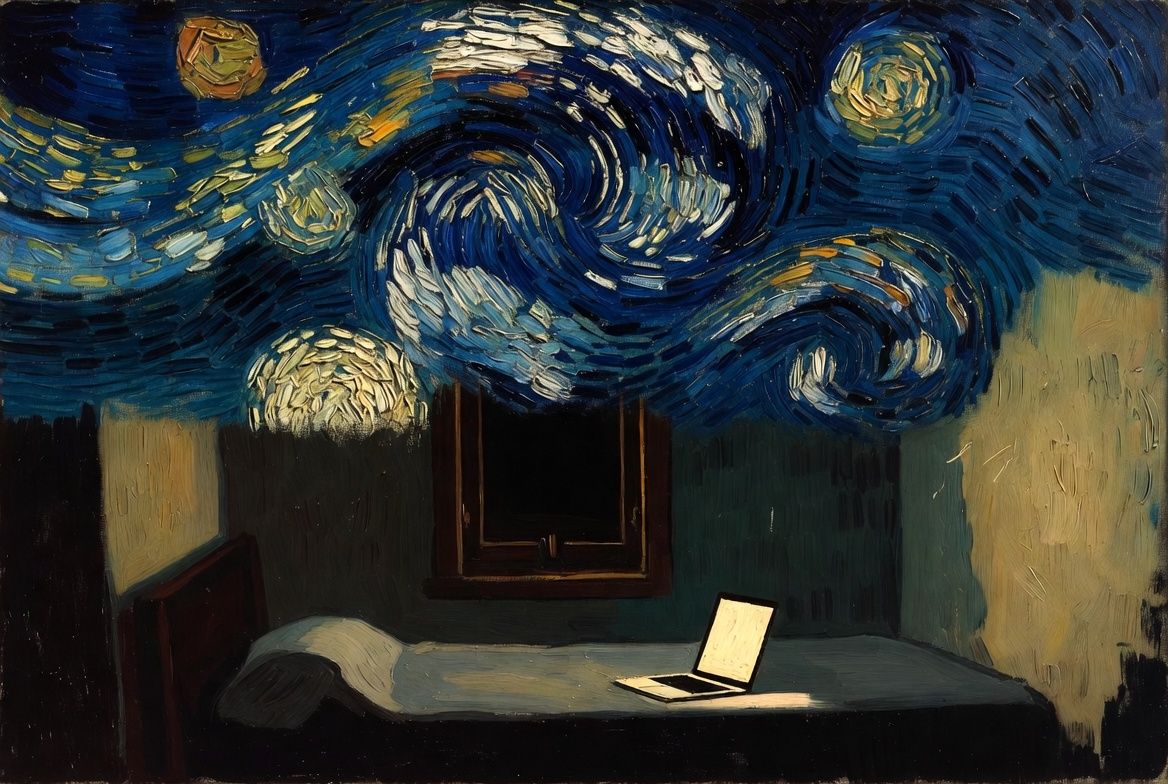
At 9:47 PM on a Tuesday, the Slack notification glows against the darkness of what used to be exclusively a bedroom. Sarah doesn’t even fully wake up to answer it—her thumb moves across the screen by muscle memory, firing off a «Sounds good!» before her consciousness has fully reassembled. By morning, she won’t remember sending it, but her nervous system will. The adrenaline spike is already circulating, the cortisol doing its demolition work on her REM cycle, her body treating a software ping like the approach of a predator.
This isn’t a scene from a research paper—quantitative data specifically tracking the physiological boundary violations of the remote era remains surprisingly fragmented, if not scarce. But it is the daily reality for millions who discovered that «working from home» often translates to «living at work.» The commute didn’t just vanish; it took with it the essential neurological airlock between the person who produces and the person who rests.
The Tyranny of the Green Dot
Remote work was sold as liberation. No more fluorescent lights, no more wasted hours in transit. What nobody accounted for was the disappearance of friction—the small hesitations that used to precede outreach. When your colleague’s physical presence required walking down a hallway, you thought twice before interrupting their lunch. Now, the green dot presumes availability. The status indicator has become a leash.
This is where the boundary crisis becomes architectural. In traditional offices, space itself enforced limits. The elevator separated floors; the parking garage separated employment from existence. Remote work flattened these layers into a single plane: the screen. And because the screen lives in your most intimate spaces—in kitchens where children eat, in bedrooms where couples argue, in bathrooms where the phone sometimes follows—the psychic contamination spreads. You don’t clock out; you simply toggle tabs.
The result is a particular flavor of exhaustion that researchers (where data exists) often describe as «cognitive porosity»—the state in which your brain never fully commits to either work or rest, hovering in a dissociative middle zone of half-attention. You answer emails while stirring pasta; you doom-scroll news during Zoom calls. Everything becomes thin.
But that’s only half the story. The other half is the guilt.
Why Saying No Feels Like Professional Suicide
Remote work introduced a new form of performative labor: the visibility of responsiveness. Without physical presence to demonstrate commitment, employees increasingly rely on speed of reply as proof of dedication. The «quick question» sent at midnight carries an implicit accusation: *Why are you still awake? Oh, you’re working too. Good.*
This creates an arms race of availability. When one team member answers the Friday evening email, everyone else feels the hot breath of obsolescence on their necks. Boundaries cease to be personal health decisions and become competitive disadvantages. To set a boundary—to let the message sit until morning—is to risk being perceived as not carrying the weight, even if your output exceeds that of the midnight responder.
This is where individual wellness advice usually fails. You can meditate all you want, but if your manager sends «just checking in» messages at 11 PM, your nervous system remains colonized. The architecture of remote burnout isn’t individual; it’s relational. It lives in the space between your intention to log off and your fear of what silence implies.
The Rebellion of the Hard Stop
Setting boundaries in the remote era isn’t about time management; it’s about territory reclamation. It requires treating your attention like sovereign land that requires visas for entry.
The most effective practitioners treat this as literal, not metaphorical. They create physical airlocks: the laptop that lives in a drawer after 6 PM, not just closed but spatially segregated. The phone that charges in the hallway, not the bedroom. These aren’t aesthetic choices; they’re neurological interventions. Your brain scans environments for triggers. If the couch cushions still hold the imprint of your work posture, your hippocampus keeps the work map active.
But physical boundaries mean nothing without temporal ones. The most radical act in remote work is the auto-responder that says, «I check messages between 9 AM and 5 PM,» not because you’re lazy, but because sustained creativity requires fallow time. Your prefrontal cortex needs the sensation of being unreachable to consolidate memories and generate insight. Constant availability doesn’t just exhaust you; it makes you worse at the job you’re trying so hard to keep.
What Managers Telegraph
Here’s where it gets interesting. Boundary-setting is contagious, but only from the top down. When a CEO sends emails at midnight, they aren’t just communicating—they’re sculpting the implicit standards of the entire organization. The language of «work-life balance» in company values becomes fraudulent chatter if the leadership team treats weekends as catch-up time.
Conversely, when managers openly block «focus time» on calendars, when they-model leaving Slack on «away» during dinner hours, they grant permission for the rest of the team to exhale. This isn’t babysitting; it’s environmental design. The health of a remote team can be measured not by its output, but by the latency of its responses—the comfortable pauses that indicate trust has replaced surveillance.
The Architecture of Switching Off
So what works? Not the soft suggestions—»try to unplug»—but the structural interventions. The «communication charter» drafted by teams that explicitly defines urgency: what constitutes a true emergency requiring evening contact versus what can compost until morning. The physical phone box by the front door where devices sleep during family hours. The shared calendar blocks that protect deep work like they protect board meetings.
Some workers are going further, experimenting with «location switching»—working from a café in the morning and home in the afternoon to create artificial commutes, or simply stepping outside to walk around the block before «arriving» back home in the evening. The body needs the ritual of transition even when the geography doesn’t change.
Others are weaponizing the technology itself: Slack statuses that read «Parenting until 8 PM,» email signatures that specify response times, the radical honesty of «I don’t answer work messages on weekends» spoken aloud in team meetings. These aren’t selfish acts; they’re infrastructure. They create the guardrails that keep everyone from driving off the cliff of burnout.
The Permission You Don’t Need
The uncomfortable truth is that most boundary violations in remote work are self-inflicted—tiny capitulations to the imagined judgment of others. The client who emails at midnight rarely expects an immediate response; they were just clearing their own inbox. The colleague who Slacks on Sunday is often relieved when you don’t answer, confirming that the world won’t collapse if they also wait.
Your nervous system is waiting for you to take the sovereignty that was always yours. The laptop doesn’t own the bedroom. The green dot doesn’t own your evening. The boundary isn’t a wall you’re building to keep others out; it’s a membrane you’re maintaining to keep yourself in—to remain intact, dimensional, capable of the deep rest that makes deep work possible.
Close the tab. The message will still be there in the morning. And more importantly, so will you.



