
The afternoon Hideo Shimizu turned ninety-four, he was not in a hospital bed or clutching a pill organizer. He was kneeling in his vegetable garden in Okinawa, Japan, tending to goya bitter melons he had no intention of selling. When researchers asked him why he bothered, he used a word that has no direct English translation: *ikigai*. «My reason to get up in the morning,» he explained. Two thousand miles away, in a survey of American adults under thirty, fifty-eight percent reported they couldn’t say the same. They lacked any «meaning or purpose» in the previous month, and half of them admitted this void was actively crushing their mental health.
This is not just a spiritual crisis. It is a medical one.
The Mortality of Meaninglessness
If you were to peer inside the data archives of the *Journal of the American Medical Association*, you would find a chilling pattern among 7,000 adults over fifty. Those who scored lowest on measures of life purpose died at twice the rate of their high-purpose counterparts within five years. Not double the rate of sadness or double the therapy appointments—double the rate of actual biological death. The effect held steady even after researchers stripped away the usual suspects: income, diet, exercise, smoking status.
In the Blue Zones—those geographic pockets where people routinely forget to die (Sardinia, Okinawa, Loma Linda)—purpose isn’t treated as a luxury item. It’s classified as a primary life support system. After accounting for genetics, the presence of strong *ikigai* (roughly translated as «reason for being») explains between seventy and eighty percent of the variance in who lives past one hundred and who doesn’t. Okinawan women don’t just outlive American women by five or ten years; they outlive them with their cognitive faculties intact and their depression rates microscopic.
The mechanism isn’t mystical. A meta-analysis pooling 66,468 participants found that purpose in life carries a robust negative correlation with depression (-0.49) and anxiety (-0.36). When you know why you’re here, your cortisol doesn’t spike as high when the email inbox overflows. Your immune system doesn’t surrender as quickly to inflammation. You don’t lie awake at three a.m. wondering if you wasted your twenties.
But here’s the rub: knowing this doesn’t make finding it any easier.
The Four-Circle Problem
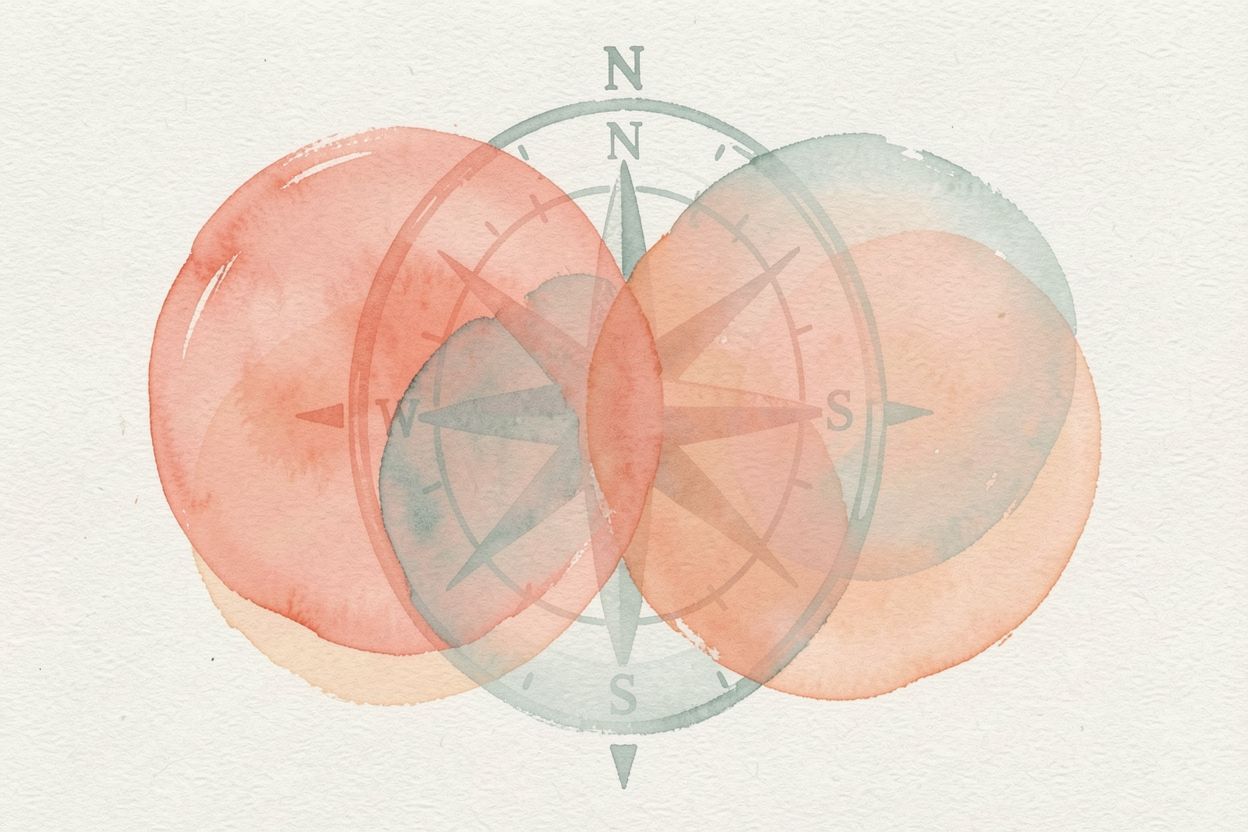
Walk into any bookstore self-help section and you’ll find *ikigai* has been gentrified. It’s been flattened into a Venn diagram sold on coffee mugs—a promise that if you just find the intersection of «what you love,» «what you’re good at,» «what the world needs,» and «what you can be paid for,» you’ll unlock the secret to happiness. The framework is not wrong, but it’s been decontextualized.
Originally, *ikigai* emerged from a communal culture where purpose was woven into intergenerational duty and small-scale agricultural labor. In Hideo Shimizu’s Okinawa, your worth wasn’t determined by your LinkedIn profile but by your contribution to the *moai*—your lifelong social support circle. When Western wellness entrepreneurs (often selling $2,000 coaching packages) repackage *ikigai* as a career-planning tool, they risk stripping away the very social scaffolding that makes purpose stick.
Yet the framework remains useful—if treated as a starting point rather than a finish line. The actual exercise, as described in practical guides and validated by career strategists, takes roughly thirty to sixty minutes of honest interrogation. You map the four quadrants not to find a perfect job title, but to locate the emotional overlap between intrinsic joy and external contribution. The goal isn’t a destination; it’s a direction.
The Evolving Target
This is where the popular narrative crashes into reality. We have been conditioned to believe purpose is a noun—a specific identity you discover like a buried treasure. The evidence suggests it is a verb, or at best, a moving target.
The same research that links purpose to longevity also reveals it isn’t static. The nurse who finds her *ikigai* in neonatal care at thirty may find it shifting toward hospice mentorship at sixty. The software developer who codes for climate solutions might pivot to teaching when the isolation becomes corrosive. The protective mental-health benefits of purpose only hold when the purpose is allowed to breathe.
Critically, the act of *searching* for purpose correlates positively with life satisfaction—but only for adolescents and young adults. For those over thirty-five, endless searching without landing creates measurable distress. The data presents a developmental paradox: you must hunt for meaning when you’re young, but you must eventually commit to something (anything) before the hunt itself becomes the pathology.
This brings us back to the fifty-eight percent of wandering twenty-somethings. Their lack of direction isn’t a character flaw; it’s a developmental stage that has been medically pathologized by a culture that demands instant specialization. But if they don’t resolve the search by their mid-thirties, the window for the protective effects begins to narrow.
The Commerce of Calling
We must address the elephant in the workshop. Much of what you will read about *ikigai* online comes from sources with a financial stake in your confusion. The «step-by-step guides» promising to reveal your purpose in an afternoon often lead to sales funnels for executive coaching or meditation app subscriptions. The studies cited are real—the JAMA mortality data, the Blue Zones epidemiology, the clinical psychology meta-analyses—but they are frequently deployed to sell certainty where none exists.
The truth is messier. While the correlation between purpose and longevity is rock-solid (high confidence), the causal arrow is not fully proven. Does purpose make you live longer, or do healthy, socially connected people simply find it easier to develop purpose? Likely both. The relationship is bidirectional, a feedback loop rather than a one-way street.
Moreover, the *ikigai* measured in Okinawan centenarians is not identical to the «career purpose» marketed by Silicon Valley leadership coaches. The original concept emphasizes small, daily pleasures and social utility over personal branding. When Sardinian youth began abandoning their agricultural communities for urban digital work, their obesity rates spiked and their *ikigai* scores plummeted—suggesting that context matters more than individual willpower.
The 58-Minute Audit
So what do we do with this information? We don’t need another TED Talk. We need a protocol.
The research converges on a simple, repeatable exercise that costs nothing and carries no commercial affiliation. Set aside one hour. Answer four questions, spending roughly ten minutes on each, then look for overlaps:
**What do I love?** (Not what impresses others, but what makes you lose track of time)
**What am I good at?** (Skills that come with unusual ease)
**What does the world need?** (Specific problems that anger or sadden you)
**What can I be paid for?** (The pragmatic constraint)
The intersection is not your «perfect career.» It is your current direction. The exercise works best when revisited quarterly, treated as a living document rather than a contract.
But the individual exercise is insufficient. The Blue Zones data reveals that *ikigai* rarely survives in isolation. It requires what researchers call «regular, low-intensity social interaction»—the daily gossip at the village square, the multi-generational household, the church group, the volunteer crew. If your purpose audit leads you to a solitary hustle, you have found a job, not a reason to be.
The Weight of the Void
We are living through a grand experiment. Never before have so many people lived so long while feeling so unnecessary. The mortality statistics from the JAMA study should terrify us not because death is frightening, but because meaninglessness is fatal. It kills you twice as fast as a bad cholesterol reading.
The good news: *ikigai* requires no special equipment, no certification, and no permission. It can begin with the octogenarian in Okinawa growing vegetables he will never sell, or the office worker in Cleveland who decides her purpose this quarter is mentoring the intern, not chasing the promotion. The evidence suggests that the content matters less than the coherence—the sense that your daily actions and your deepest values are steering the same boat.
Fifty-eight percent of young adults are drifting. But drift is not destiny. The data is clear: those who stop drifting, who pick a direction and adjust course as needed, don’t just feel better. They stay alive.