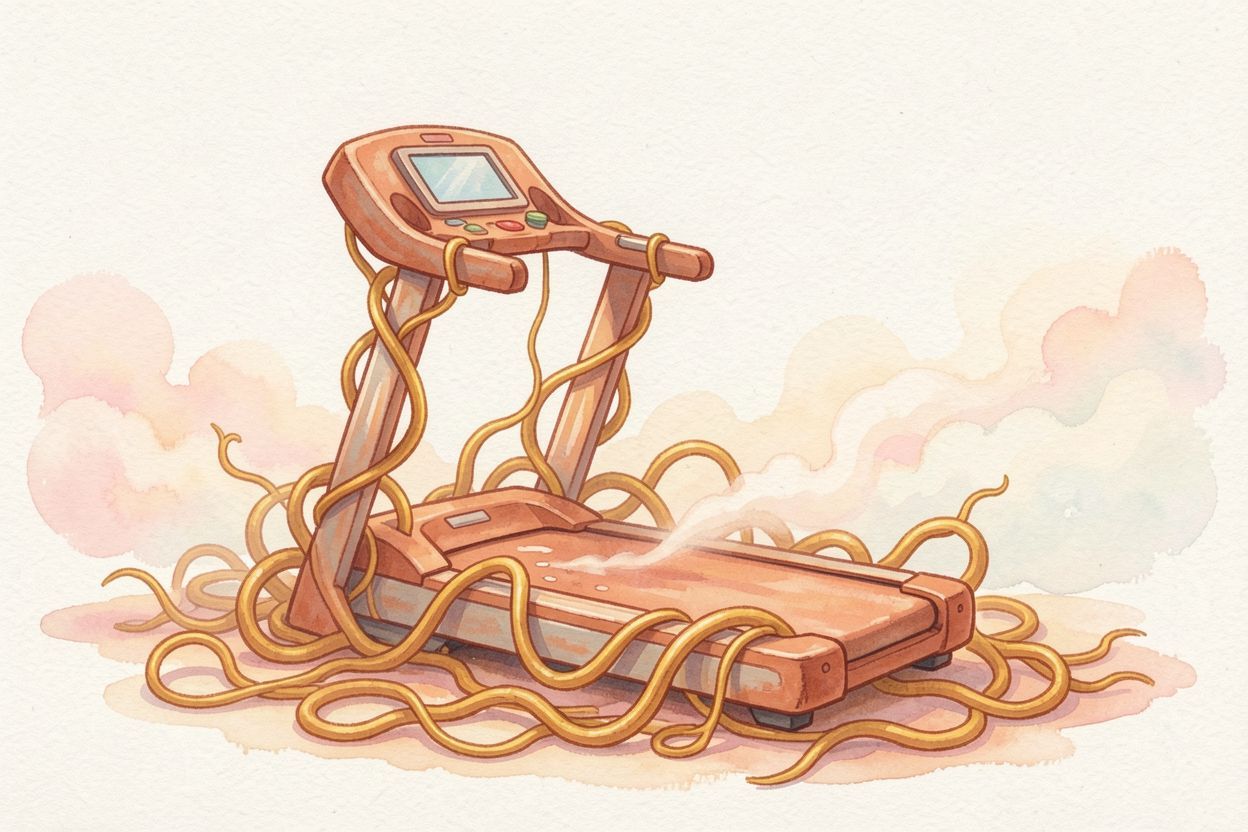

Six months after winning $50,000 a year for life, most people report being exactly as happy as they were before they bought the ticket. The new car smells like cardboard and possibility for exactly three weeks. The promotion stops feeling like victory and starts feeling like Tuesday. We are, as psychologists have grimly noted, creatures built to habituate—to sour on splendor and normalize the miraculous. This is hedonic adaptation, and it explains why the pursuit of happiness so often feels like running on a treadmill that’s gainfully speeding up.
The Set Point: Your Emotional thermostat
Imagine your happiness as a thermostat set to a specific temperature. Crank the heat up by winning the lottery or getting married, and the system eventually cools back down. Crashing the car or getting divorced sends the temperature plummeting, but the internal machinery slowly, stubbornly, warms things back to baseline. This isn’t metaphor; it’s measurable biology. Twin studies suggest roughly half of your happiness variation is hardcoded in your genes—a «set point» that functions like a psychological homeostasis. Life circumstances—your zip code, your salary, whether you drive a Honda or a Mercedes—account for a measly 10%.
The remaining 40% is where things get interesting. This slice sits entirely within your control, a fact that should terrify and liberate you in equal measure. It represents intentional activities: the thoughts you cultivate, the relationships you tend, the way you process Tuesday afternoon. But before we exploit that 40%, we need to understand why the thermostat exists in the first place.
Why We Can’t Keep a Good Thing: The Mechanism
In 1978, researchers Brickman, Coates, and Janoff-Bulman published a study that still echoes through psychology departments. They compared recent lottery winners with accident victims who had become paraplegics. Eighteen months later, the lottery winners were barely happier than control subjects, while the accident victims—though devastated—had inched back toward their previous emotional baseline. The thrill of sudden wealth had evaporated; the trauma of paralysis had softened. The brain, it seems, treats emotional spikes the way the eye treats a flash of light: by adjusting its sensitivity until the novelty disappears.
This happens through two primary pathways. First, aspiration levels shift. Get the raise, and immediately your reference point moves—you no longer compare yourself to your former salary, but to your boss’s salary, or to what you thought the raise would feel like. Second, emotional frequency declines. The tenth time you drive the sports car produces less dopamine than the first. Psychologists Sheldon and Lyubomirsky call this the HAPNE model: Hedonic Adaptation Prevention and Positive Emotion. Without intervention, we slide back to neutral.
But here’s the asymmetry that truly matters. While positive events typically lose their punch within months, negative events linger like unwelcome houseguests. Unemployment or bereavement can drag on your well-being for fifteen to eighteen years. Divorce creates a happiness deficit that decades of data show is stubbornly persistent. We’re wired with a negativity bias that makes adaptation to good fortune swift and adaptation to misfortune glacial. Evolution needed us to notice the tiger in the grass more than the sunset on the savanna, and that ancient wiring now means your brain metabolizes joy faster than sorrow.
The Exceptions: When Happiness Sticks
If adaptation were absolute, psychology would be a discipline of despair. But the set point isn’t concrete; it’s clay. Roughly 24% of people show significant shifts in their baseline happiness over seventeen years, and certain experiences prove surprisingly resistant to the treadmill’s erosion.
Take plastic surgery. Patients who undergo cosmetic procedures report elevated happiness lasting three to twelve months—a notable exception to the rapid fade. Or consider the polar explorer Aleksander Gamme, who after months of Antarctic isolation, stumbled upon a buried cache of food he’d forgotten he packed. The joy of that reunion with a simple candy bar was filmed and went viral—not because of the sugar, but because the deprivation had reset his pleasure baseline. This is the «hedonic reset»: temporarily removing a pleasure so that its return feels like discovery rather than routine.
Relationships, when actively cultivated, also resist corrosion. Marriage doesn’t automatically make you happier after the honeymoon ends—in fact, the «marital hangover» often dips below baseline within two years—but couples who engage in novel shared activities maintain elevated satisfaction. The relationship itself becomes a vehicle for variety, preventing the desensitization that kills solo pleasures.
Hacking the Treadmill: The 40% Solution
Since you can’t change your genetics and circumstances only nudge the needle, lasting happiness requires targeting that 40% slice of intentional activity. But not all activities are equal. Chasing «hedonic» pleasures—fancy dinners, new gadgets, back-to-back streaming sessions—accelerates adaptation because they’re passive and predictable. The antidote lies in «eudaimonic» pursuits: activities linked to meaning, growth, and competence.
Savoring is your first weapon. When something good happens—sunlight on your face, a compliment from a colleague—don’t just let it wash over you. Mentally photograph it. Share it with someone. By maintaining attention on positive stimuli, you slow the neurological process of habituation. One study found that the «Best Possible Selves» exercise—spending twenty minutes writing about your future if everything goes right—not only boosted hedonic happiness immediately but maintained those gains a week later, defying typical adaptation curves.
Gratitude journaling operates like a manual override for the negativity bias. By forcing attention to what hasn’t been lost, you counteract the brain’s tendency to habituate to the good. The key is specificity and scarcity; writing «I’m grateful for my spouse» every day becomes noise, but noting «I’m grateful she remembered my coffee order when I was stressed» reactivates appreciation through novelty.
Variety is the ultimate adaptation antidote. The brain responds to contrast. Rotate your pleasures. If you love Italian food, eat it less often. If you have a favorite song, save it for specific moods. Strategic deprivation—Gamme’s accidental discovery—creates the contrast necessary for joy to register.
The Cultural Footnote
Not everyone runs on the same treadmill at the same speed. When researchers tested gratitude interventions with Portuguese participants, they found unexpected negative effects; the cultural context around self-reflection and leisure shifted how the exercise landed. Adaptation rates also vary by domain—we adapt quickly to income changes but slowly to health changes—suggesting that your set point is less a single thermostat and more a complex dashboard with multiple gauges.
The Hard Truth and the Hope
The research presents a paradox that Oliver Burkeman summarized with unsettling clarity: «You want something because you think it’ll make you happy, and maybe it does, briefly. But then the new thing loses its shine and you revert to your earlier, less happy state.» This is the hedonic treadmill, and we are all, in some sense, trapped on it.
But trapped doesn’t mean doomed. The genetic hand you were dealt accounts for half the game, but the other half is player agency. You cannot sustain a happiness high indefinitely—that’s not how nervous systems work—but you can raise your baseline through the disciplined pursuit of meaning over comfort, relationships over possessions, and appreciation over consumption.
The fix isn’t a one-time upgrade; it’s a practice of strategic discontent—removing pleasures so you can re-encounter them, sharing moments so you remember them, and choosing the slow-burn satisfaction of competence over the quick hit of convenience. The treadmill never stops, but you can learn to adjust the incline.