
The first time she said no, her hands shook. Not from fear of the request—an after-hours work assignment, unpaid, deadline «ASAP»—but from the physiological shock of declining. Her heart rate spiked. Her throat tightened. The guilt arrived like a physical blow, immediate and nauseating.
She had expected punishment. She got something else entirely.
This is the paradox at the heart of boundary-setting, a psychological practice that has migrated from therapist’s offices to Instagram carousels to corporate wellness seminars: the word we experience as rejection is actually the foundation of connection. The act we perceive as selfish—drawing a line, saying «no,» defining where we end and others begin—is, according to the available evidence, one of the few reliable predictors of both relationship survival and individual sanity.
But here is where the story gets complicated. While mental health advocates and therapists unanimously champion boundaries as «the gateway to healthy relationships,» citing protection from resentment and burnout, the empirical foundation beneath this advice is surprisingly thin. Of nineteen potential sources reviewed for this analysis, only three contained substantive research; the rest were empty or inaccessible. The one quantitative claim—that clear boundaries increase relationship satisfaction by 40%—arrives without a verifiable citation to a peer-reviewed study. We are, in other words, building a case for emotional architecture on a scaffold of consensus rather than concrete data.
The Guilt Is the Point
To understand why boundaries work, you must first understand why they hurt. According to the Depression and Bipolar Support Alliance (DBSA) and clinical sources, the discomfort of saying no—typically manifesting as guilt, shame, or anxiety—is not a signal that you are doing something wrong. It is evidence that you are breaking an old pattern.
This reframing is crucial. For many, particularly those socialized to equate love with self-sacrifice, setting a limit triggers a threat response similar to physical danger. The body reacts to the «danger» of disappointing others before the rational mind can assess whether the request was reasonable in the first place. Therapists describe this as the central challenge of boundary implementation: the nervous system must be retrained to recognize that self-preservation is not aggression.
The mechanics of this retraining rely on two skills that sound simple but execute with difficulty: self-awareness and radical clarity. First, you must identify the limit—»I am not available for work calls after 6 p.m.» or «I cannot take responsibility for your emotional reaction to my decision.» Then, you must communicate it without the customary fortress of apologies, justifications, or explanations that we typically mortar around our refusals. As one clinical framework suggests, the template is almost stark in its simplicity: «I feel [emotion] when you [behavior] because [impact]. What I need is [boundary].»
Bridges, Not Walls
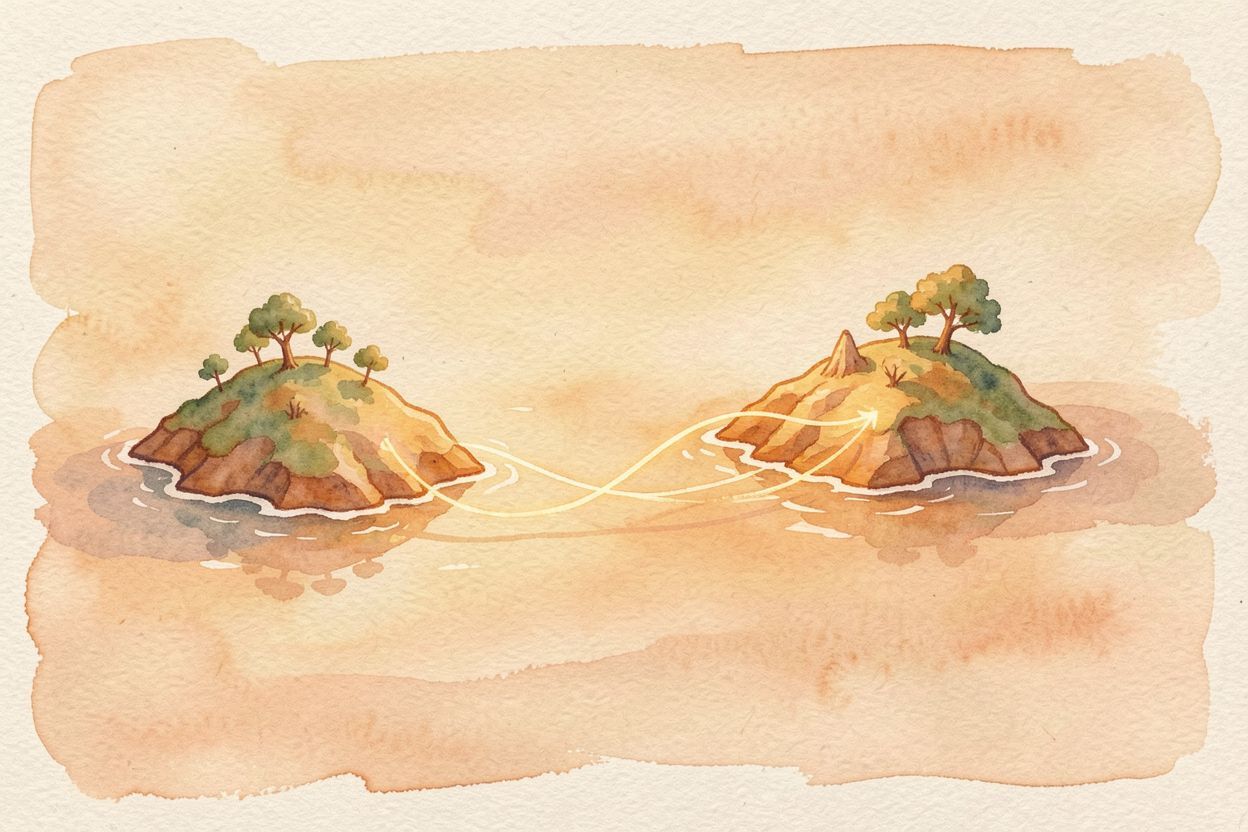
If boundaries are so essential, why do so many of us experience them as relational violence? The research suggests a semantic problem. We have been conceptualizing boundaries as barriers—as mechanisms to keep people out—when they function more accurately as bridges.
This distinction matters because it changes the psychological math of commitment. When you fail to set boundaries, according to the therapeutic consensus, you do not create more intimacy; you create resentment. You agree to the dinner party when you are exhausted, the extra project when you are drowning, the favor that requires you to borrow against your own wellbeing. These accumulated unpaid debts of energy eventually calcify into burnout, anxiety, and a peculiar form of relational dishonesty where you are physically present but emotionally bankrupt.
Conversely, when you say no, you are performing what therapists call «a yes to yourself.» This is not mere wordplay. The act of refusal preserves the resources necessary for authentic engagement. It prevents the slow erosion of goodwill that comes from unmet, uncommunicated needs. Paradoxically, by limiting what you will give, you ensure that what you do give is offered freely rather than extracted under duress.
But this is where the evidence base shows its seams. While the logic is sound and the clinical anecdotes are abundant, the research lacks the longitudinal rigor to confirm that boundary-setting definitively causes long-term happiness. We know that burnout decreases and anxiety lessens when people assert limits; we have less data on whether those benefits persist over years, or how they interact with socioeconomic factors like job insecurity or caregiving responsibilities.
The Italian Exception
Then there is the data point that complicates everything.
In a 2019 study of 104 dual-earner couples in Italy—a culture with specific traditional gender norms—researchers discovered that boundary violations did not always damage relationships. In fact, when men allowed their family lives to interrupt their work (taking a call from a partner during office hours, for example), their female partners reported significantly higher relationship satisfaction. The effect was specific: men’s visible accessibility signaled engagement and care in a context where emotional availability from husbands was not traditionally assumed.
This finding does not invalidate the boundary thesis. Rather, it illuminates a critical nuance often missing from the self-help prescriptions: boundaries are not universal constants but negotiated currencies. Their meaning depends on the relational ecosystem. A «violation» in one context—say, a boss texting on a Saturday—may be a «connection» in another.
The Italian study serves as a necessary corrective to the one-size-fits-all boundary industrial complex. It suggests that rigid, individualistic boundary-setting may miss the point in collectivist or traditionally gendered contexts, where flexibility across domains can function as a love language. The goal is not to build impermeable walls, but to establish limits that are clear enough to create safety and flexible enough to allow for care.
The Practice of Refusal
Given the gaps in the research, how should one proceed? The therapeutic consensus, for all its lack of quantitative backing, offers a coherent practice that resembles training a muscle.
Start small. Choose a low-stakes limit with a safe person before attempting to renegotiate decades-old family dynamics. Expect the guilt—treat it as data that you are challenging an old pattern, not as evidence of your selfishness. Use «I» statements that own your experience without diagnosing the other person’s character: «I cannot commit to that» rather than «You are asking too much.»
And crucially, examine your context. Are you living in a culture that equates busyness with worth? A family system that punishes autonomy? A workplace that weaponizes urgency? The difficulty of your boundary may be less about your personal failings and more about the toxicity of the environment requiring the fence.
The Uncomfortable Truth
We are living through a cultural moment obsessed with optimization—of time, of energy, of relationships. In this landscape, «setting boundaries» has become a kind of emotional hygiene, a way to curate our inputs for maximum output. The research, however, suggests something messier and more human: boundaries are imperfect, relational, and often painful tools for maintaining the self in a world that constantly demands its dissolution.
The woman whose hands shook when she declined that assignment? She reported back three months later that her colleagues had adjusted. They began asking earlier, respecting her hours, and—ironically—trusting her «yes» more completely because they knew her «no» was real.
The data may be thinner than the advice suggests. But the intuition—that we cannot pour from an empty cup, that resentment is the poison of unclear limits, that saying no is sometimes the most honest form of yes—holds up under scrutiny. The boundary is not the wall that ends the relationship. It is the definition of the self that makes any real relationship possible.