
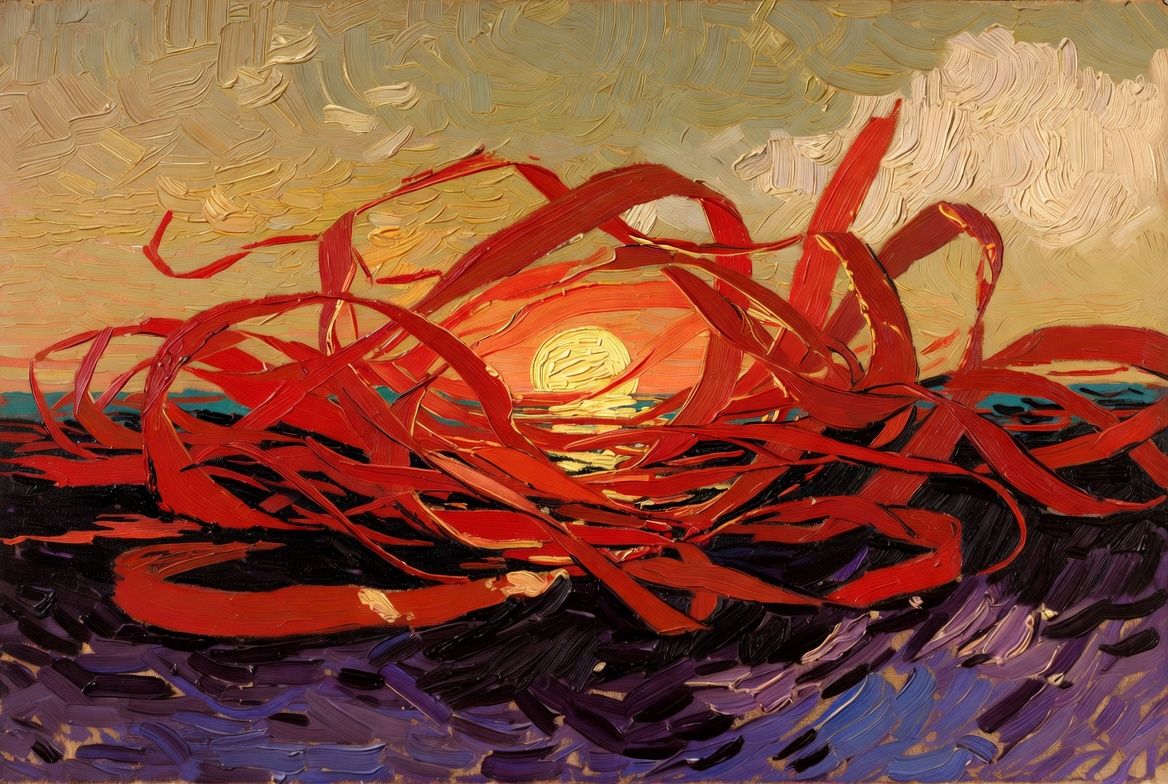

Your Alarm Clock Is a Trap Door
You set it to prevent oversleeping. Instead, it launches a daily ambush. Your eyes open—not to the ceiling, not to your partner, not to the light spilling through the curtains—but to a glowing rectangle demanding immediate triage before your feet touch the floor. Email. News alerts. A Slack message from someone three time zones away who decided 6:00 AM your time was the perfect moment to «circle back.» You haven’t stood up yet, and already your nervous system is underwriting a crisis that doesn’t exist.
Welcome to the attention economy’s perfect crime: it has convinced us that perpetual vigilance is a form of competence.
The Infinite Scroll and the Anxiety Loop
We call it «doomscrolling»—that hypnotic, thumb-driven trance through catastrophic headlines and comment sections that leave us simultaneously overstimulated and hollow. But the mechanics are older than smartphones. It is variable-ratio reinforcement, the same psychological architecture that keeps gamblers pulling slot machine levers. The feed never promises satisfaction; it only promises * possibility*. Maybe the next swipe reveals a joke. Maybe it reveals a war. The uncertainty itself is the drug.
This is where it gets interesting. Doomscrolling isn’t just a habit; it’s a displacement activity. When we feel the ambient anxiety of modern life—climate dread, economic precarity, the low-grade hum of isolation—we reach for the phone not despite the bad news, but because bad news offers a focal point. The scrolling provides the illusion of control. At least we are *doing* something, even if that something is watching the world burn in 280-character increments.
But that’s only half the story. The other half lives in your pocket’s Pavlovian symphony.
Notification Anxiety: The Tyranny of the Red Badge
We have engineered a system where every app is a needy toddler tugging at our hem. The red badge—a数字 so urgent it demands a gold rush—is not a request; it is a neural hijacking. Each ping triggers a micro-flood of cortisol. Is it your boss? A family emergency? Or just another retailer informing you that items in your cart are «selling fast»?
The cruelty lies in the intermittent reinforcement. If every notification were crucial, we would triage ruthlessly. But because the important arrives scrambled with the trivial—a cardiac arrest of a text next to a promotional code for socks—our brains default to hypervigilance. We treat every buzz as a potential threat, which means our threat detection systems never stand down. The battery icon glows orange, but it is our own nervous systems that are perpetually in low-power mode.
Your Brain on Infinite Tabs
Here is what happens neurologically, stripped of jargon. The prefrontal cortex—your internal CEO responsible for long-term planning and emotional regulation—gets bypassed. The limbic system, your brain’s smoke detector, takes the wheel. Decision-making becomes reactive, not deliberative. We do not choose to pick up the phone; we reflexively reach to extinguish a sensation of wrongness, like scratching an itch that worsens the more we attend to it.
The result is a fractured attention span that cannot distinguish between urgency and importance. You can read three articles about geopolitical collapse and emerge unable to remember why you opened the refrigerator. This is not stupidity; it is the cognitive load of context-switching without closure.
The Detox Isn’t a Monastery
Digital detoxing has been marketed as a luxury retreat—thirty days in a cabin without Wi-Fi, certificate of completion optional. This misses the point entirely. Reclaiming attention is not about ascetic denial; it is about architectural redesign of your relationship with technology.
The goal is not to become a digital monk. It is to become a digital *citizen*—one who uses tools rather than being used by them.
Start with radical friction. Humans are path-of-least-resistance creatures, so make the path to distraction mountainous. Delete the apps that monetize your anxiety—not just from your home screen, but entirely. Access Twitter or Instagram through the browser, where the experience is deliberately clunky, stripped of infinite scroll optimizations and push notifications. If you need to post, post. Then close the tab. The inconvenience is the feature.
Reclaim your mornings. The first hour after waking is when your brain is most plastic, most capable of deep work or genuine presence. Do not surrender it to the algorithmic firehose. Buy an analog alarm clock. Charge your phone in the kitchen, not the bedroom. When you wake, you should encounter your own consciousness before you encounter the world’s demands.
Calibrate your notifications as if your sanity depends on it—because it does. Turn everything off except direct messages from humans you would let into your house during a medical emergency. Group texts can wait. Marketing blasts can wait. The news will still be terrible in three hours; your cortisol spike need not be real-time.
But the most radical act is also the simplest: rebuild your capacity for boredom. The minute you feel the urge to fill a pause—the elevator ride, the grocery line, the pause between conversations—resist. These liminal spaces are where creativity gestates. When you floods them with TikToks and headlines, you don’t just lose time; you lose the generative silence from which ideas emerge.
Attention Is the Last Currency
We are living through the largest unregulated psychological experiment in human history, and the test subjects are us. The platforms know exactly how to monetize our fear and our FOMO. They will not stop. They cannot stop; their stock prices depend on our compulsion.
This means the only firewall left is individual—tiny, deliberate acts of refusal. Not dramatic farewells to technology, but quiet boundaries. Choosing to look at the tree instead of the photo of the tree. Finishing a book without checking how many pages remain. Listening to a friend without the half-anxiety of wondering what vibration just occurred in your pocket.
Your attention is finite and non-renewable. Every second you spend in the scroll is a second you are not living in the only place life actually happens: right here, right now, beyond the glass.



