

The Meal You Missed This Morning
You ate breakfast today, didn’t you? Check your memory. Was it toast, coffee, a banana grabbed between meetings? Now try this: what did it actually taste like?
If you draw a blank, you are not alone. Research suggests we make over 200 food decisions daily, yet remain mentally absent for the majority of them. We eat in SUVs, over keyboards, while doom-scrolling through news feeds. The food goes in; we experience nothing. And then we wonder why we feel anxious, unsatisfied, and strangely hungry again twenty minutes after finishing a meal.
This is the central paradox of modern eating: we have never had more access to food, and never been more disconnected from the act of consuming it. The result isn’t just expanding waistlines—it’s a fractured relationship with our own bodies, and a stress response that hijacks our digestive systems before we’ve even swallowed the first bite.
Your Second Brain Is Listening
The gut contains 100 million neurons—more than the spinal cord. Scientists call this the enteric nervous system, but you might better understand it as your body’s quiet commentator on every aspect of your life. When you eat under deadline pressure, these neurons register the cortisol flooding your system. They initiate a chain reaction: reduced digestive enzyme production, increased inflammation, and impaired nutrient absorption.
In other words, you can eat the perfect organic kale salad, but if you consume it while answering hostile emails, your body treats it as a threat.
The food-mood connection operates through several channels simultaneously. Blood sugar spikes and crashes from hurried eating trigger irritability and brain fog. The vagus nerve—the superhighway between gut and brain—transmits distress signals in both directions. Meanwhile, the microbiome, that pounds of bacteria living in your intestine, produces neurotransmitters like serotonin and dopamine; stress eating disrupts their balance, creating cravings for exactly the kinds of foods that deepen the anxiety.
This is where it gets interesting: the relationship isn’t destiny. Unlike your genetic code, this is a conversation you can learn to moderate.
The Ritual of the First Bite
Mindful eating is not, despite popular misconception, simply «eating slowly while being grateful.» Nor is it a diet masquerading as wellness. It is a specific cognitive practice borrowed from Buddhist meditation traditions and validated by contemporary neuroscience: the deliberate direction of attention to the sensory experience of eating.
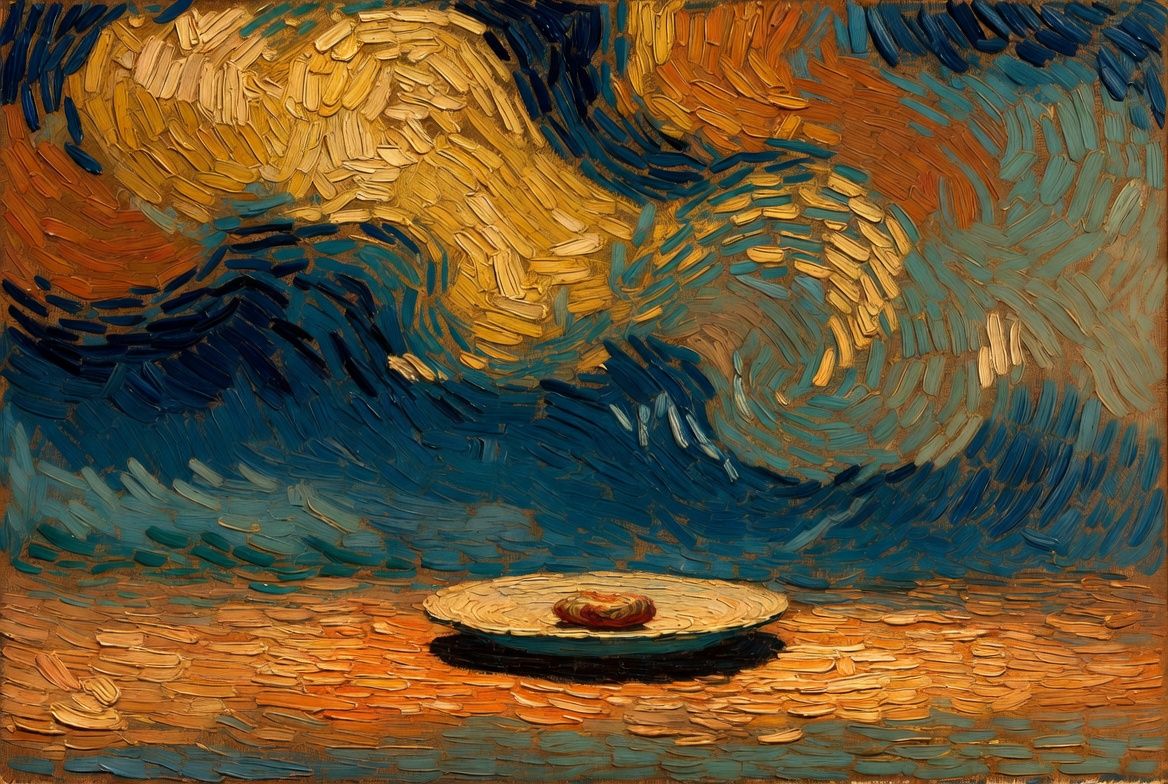
Start with what practitioners call «eating meditation»—a technique that sounds absurdly simple until you try it. Place a single raisin (or piece of chocolate, or almond) in your palm. Do not put it in your mouth. First, observe it as if you’ve never seen such an object. Notice the ridges, the color variations, the weight against your skin. Smell it. Then, place it on your tongue and wait. Chew once. Twice. Detect the shift in texture, the release of sugars, the way saliva activates.
Most people last fifteen seconds before their minds wander to grocery lists or work anxieties. The practice is not the raisin; it is the return. Each time you notice your attention has drifted and you bring it back to the sensation of chewing, you strengthen neural pathways associated with interoceptive awareness—your brain’s ability to read your body’s actual needs rather than its anxiety-driven demands.
The Hunger-Fullness Loop
Human beings possess sophisticated satiety mechanisms, but modern eating bypasses them completely. It takes approximately twenty minutes for the brain to register fullness. When you consume a sandwich in four minutes while typing, that signal never arrives in time. You eat past fullness, experience physical discomfort, then add psychological guilt—creating stress that triggers the next episode of mindless eating.
Conscious eating interrupts this loop by reintroducing what researchers call the «mid-meal pause.» Halfway through your plate, simply stop. Set down your fork. Ask: what is my body telling me now? This isn’t about restriction; it’s about data collection. You are gathering intelligence on your own biological reality.
Many people discover they have been confusing anxiety with hunger, thirst with cravings, or boredom with the need for oral stimulation. These distinctions matter because they determine your interventions. Anxious eating requires calming techniques; hungry eating requires food; bored eating requires engagement with your actual life.
When the Kitchen Becomes a Sanctuary
Transforming your relationship with food requires abandoning the morality play. There are no «good» or «bad» foods in mindful practice—only foods eaten with awareness and foods eaten while dissociated. A chocolate chip cookie consumed with full presence and enjoyment often satisfies more completely than three eaten distractedly, and leaves less residual guilt.
The environmental design matters. Research indicates that eating in the same location where you work—or worse, where you experience stress—conditions you to associate food with those emotional states. Creating a dedicated eating space, even if it’s just a specific corner of a studio apartment, triggers a context shift. Your brain recognizes: here, we do one thing only.
Phone off. Screen dark. The meal becomes a thirty-minute island in your day, protected not by rigidity but by the recognition that multitasking during meals is not productivity—it is theft. You are stealing from your own capacity to taste, to digest, to feel satisfied.
The Resistance You Will Feel
Here is what the wellness blogs don’t tell you: this practice is boring. Profoundly, maddeningly boring at first. Your brain, addicted to the dopamine hits of constant stimulation, will rebel against the slowness. You will find yourself reaching for the phone without conscious decision. You will realize you’ve eaten half a meal without tasting it, again.
This resistance is the point. Every time you notice you’ve drifted and return to the sensation of the food, you are doing the work. You are training an attention muscle that has atrophied in a culture of constant distraction. The boredom is the edge where transformation happens.
What Changes
After several weeks of practice, the shifts are subtle but seismic. You might notice you naturally stop eating when satisfied, not when stuffed. You may discover that certain foods you’ve eaten for decades actually taste disappointing when fully attended to—processed snacks designed for texture and salt concentration rather than genuine nourishment. You might find that stress no automatically equals «need food,» but instead equals «need breath, need walk, need rest.»
The stress reduction comes not from the food itself, but from the removal of the eating-stress-eating cycle. You are no longer fighting your body; you are listening to it. And bodies, it turns out, are more reasonable negotiation partners than we give them credit for, when we finally stop shouting over them with our anxieties.
Your next meal awaits. You could eat it the way you ate breakfast—invisibly, mechanically, gone before it arrived. Or you could taste it. The choice is yours, moment by moment, bite by bite.



