
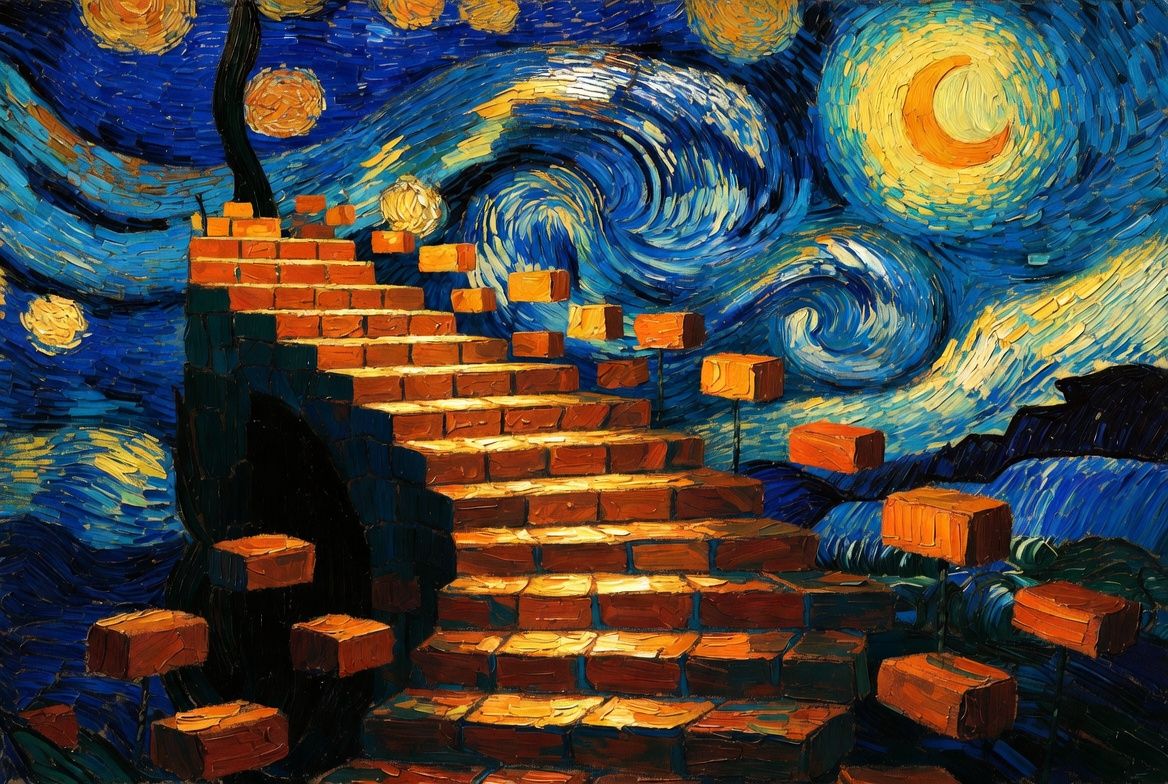

Only twenty-five percent of adults can articulate what gives their life meaning. The rest are waiting for a revelation that research suggests will never arrive—a single, cinematic moment when the clouds part and destiny announces itself with trumpet fanfare. But here is the uncomfortable truth emerging from decades of psychological study: purpose is not discovered like buried treasure. It is built, brick by experimental brick, through a process that looks less like archaeology and more like architecture.
The Myth of the Lightning Bolt
We have been sold a story about purpose that resembles a romantic comedy plot: you wander through life confused until one day, suddenly, you meet «The One.» Your true calling. Your reason for being.
Except it almost never happens this way. Studies tracking how people actually find meaning reveal a messier, more iterative path. Purpose emerges not from epiphany but from sustained engagement with the world—testing, failing, recalibrating. The people who report the strongest sense of direction are not those who experienced a singular moment of clarity, but those who treated life as a laboratory, running small experiments with different activities, relationships, and challenges until patterns emerged.
Viktor Frankl, the psychiatrist who survived Nazi concentration camps and later founded logotherapy, observed this dynamic nearly eighty years ago. Meaning, he argued while writing *Man’s Search for Meaning*, does not come to us while we wait; we create it through our actions and attitudes. Modern research has vindicated him. The brain’s reward system activates not when we contemplate our purpose abstractly, but when we engage in purposeful activity, creating a positive feedback loop that encourages further meaningful action.
Where the Self Meets the World
But here is where the blueprint gets complicated. Purpose requires a specific alchemy: the intersection of what you care about and what the world needs.
Research consistently shows that purpose flourishes at this collision point between internal values and external contribution. Martin Seligman, the founder of positive psychology, distinguishes between happiness—which he links to love given and received—and purpose, which emerges from creating meaning through service. Longitudinal studies tracking participants over decades, including the Harvard Study of Adult Development, reveal that those whose work connects personal strengths to community needs report significantly higher life satisfaction than those pursuing either self-interest alone or purely altruistic sacrifice.
This creates a tension that researchers still debate: Should purpose be self-focused or other-focused? The data suggests a both/and rather than either/or proposition. Pure hedonism feels hollow; pure martyrdom leads to burnout. The most resilient purposes act as bridges, carrying your unique capabilities across to meet the world’s specific gaps.
The Shape-Shifting Nature of Calling
If you feel you missed your chance to find purpose in your twenties, good news: you were looking for the wrong thing in the wrong decade anyway.
Developmental psychologists have mapped how purpose transforms across life stages, often in response to crisis or transition. The narrative we construct about our lives is not static; we continually reinterpret past events to make sense of our present direction. A job you took for money in your thirties becomes the training ground for your mission in your fifties. A loss that devastated you becomes the source of your empathy.
This evolutionary quality contradicts the popular notion of a «true calling» waiting to be uncovered like fossilized bone. Instead, purpose behaves more like a living organism, adapting to new ecosystems as you age. The Harvard Study of Adult Development, which has tracked participants for over eighty years, reveals that those who maintained a sense of meaning were not those who clung to youthful ambitions, but those who allowed their definitions of purpose to mature alongside them.
The Mortality Advantage
The stakes for this work are higher than mere satisfaction. They are biological.
People with a strong sense of purpose live longer—approximately seven years longer, according to research published by the American Psychological Association. They also show reduced rates of depression, with purpose-focused interventions demonstrating a thirty percent decrease in symptoms compared to traditional approaches.
Neuroscientific evidence suggests this is not coincidence. When we engage in purposeful activities, our brains light up in specific ways that reinforce continued engagement, creating what psychologists call «eudaimonic» well-being—a deep, sustained sense of fulfillment distinct from fleeting pleasure. Your body literally rewards you for meaning-making.
The Cultural Blind Spot
But before we prescribe purpose-seeking as universal medicine, a caveat: most of what we know about finding meaning comes from a narrow slice of humanity.
The majority of purpose research derives from Western, educated, industrialized populations. Whether the pursuit of individual purpose functions the same way in collectivist cultures, or whether the concept itself translates across different value systems, remains understudied. The tension between self-actualization and communal obligation may resolve differently in societies that prioritize group harmony over individual calling.
This gap matters because it suggests our current models—values clarification, strengths assessment, personal experimentation—may reflect cultural biases toward individualism rather than universal truths about human flourishing.
Building Instead of Finding
So how do you construct something you have been conditioned to wait for?
Start with values clarification, but do not stop there. Identify what matters to you, then look for the overlap with what hurts in your community. Run purpose experiments: volunteer for three months, shadow someone in a field that intrigues you, or build something small. These are not commitments but data-gathering missions. Notice when you enter flow states—those moments when time disappears and you forget to check your phone. These are breadcrumbs leading toward architecture, not archaeology.
Seek mentors not to copy their path, but to study their process. How did they pivot when their first purpose proved incompatible with reality? How did they rebuild after failure?
Most importantly, abandon the search for a single, immutable answer. The twenty-five percent of people who report strong purpose are not those who found the truth, but those who stopped waiting and started building. They recognized that purpose is not a noun to be discovered, but a verb to be practiced—daily, imperfectly, and with the understanding that the blueprint keeps changing.
Your life meaning is not hiding in the future, waiting to be revealed. It is hiding in your calendar, waiting to be constructed.



