
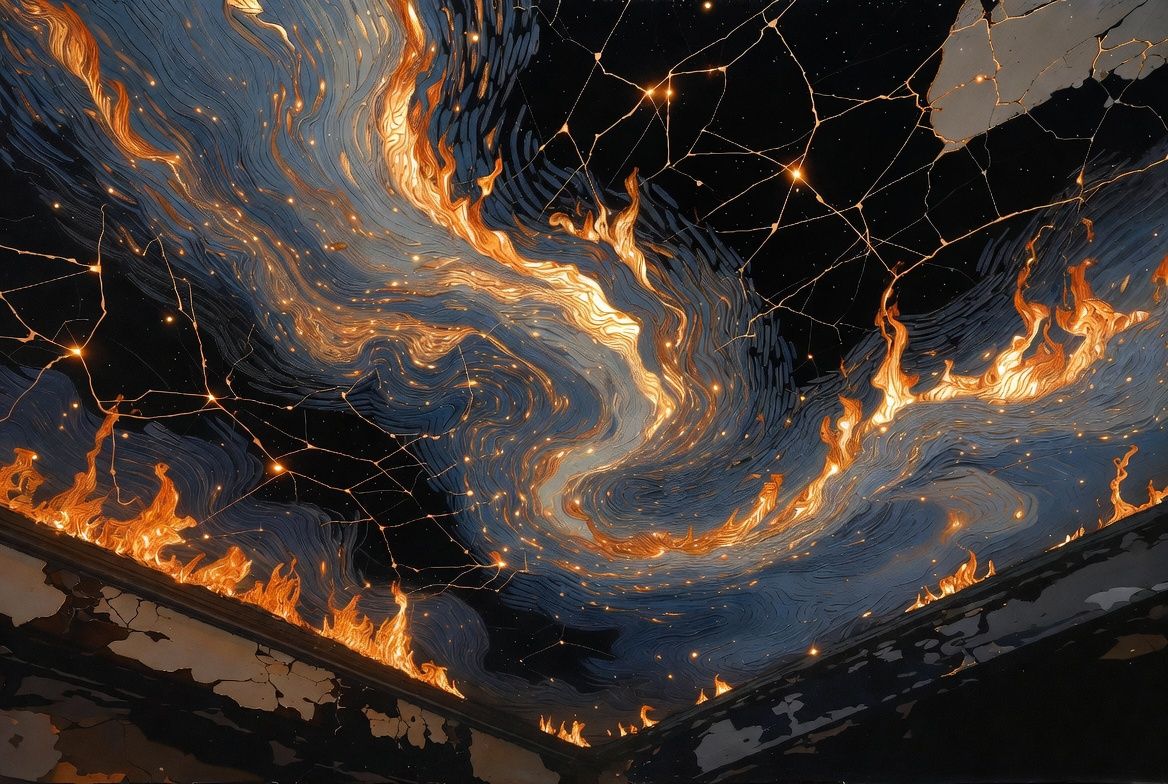

The Ceiling Is on Fire, and You’re Still Checking Email
Three out of every four people reading this sentence are currently burning alive—metaphorically speaking—and most haven’t smelled the smoke yet. Global data from Liv Hospital (2026) puts the number at 76% of employees exhibiting burnout symptoms, while a Deloitte survey cited by the Stress and Growth Counseling Group suggests the figure hits 77% among American full-time workers. We’re not talking about having a rough week or needing a vacation. We’re talking about a progressive, multidimensional collapse of the human system that the World Health Organization now classifies specifically as an occupational phenomenon—not a medical disorder, not a personal failing, but a workplace-induced injury.
But here’s the real kicker: the people most likely to be burning are the ones you’d never suspect. They’re the ones who just answered your Slack message at midnight, who never miss a deadline, who describe themselves as «passionate» about industries that are slowly digesting them alive. This is «quiet burnout,» a phenomenon identified by the Stress and Growth Counseling Group, where high-performers mask their depletion behind a facade of perfect work-life balance until the circuitry fries completely. By the time they stop showing up to the office, they’ve usually been gone for months.
The Three-Front War Inside Your Body
Burnout isn’t just «stress.» Stress is your engine revving too high; burnout is when the engine seizes while the radio keeps playing. According to the Maslach Burnout Inventory framework—validated across decades of research—the syndrome attacks on three simultaneous fronts, and missing any one of them means missing the diagnosis entirely.
First comes the **intrapersonal** domain: the bone-deep exhaustion that sleep doesn’t touch, the anxiety that hums beneath your skin like electricity. This is emotional exhaustion in the clinical sense—feeling emotionally overextended and depleted of your internal resources. Then the **interpersonal** front collapses: you withdraw from colleagues, your relationships strain at the seams, and you develop what researchers call depersonalization—a cynical detachment that treats people like obstacles. Finally, the **occupational** domain crumbles: productivity doesn’t just drop; it becomes meaningless. You experience what’s termed «reduced professional efficacy»—the haunting sense that nothing you do matters, even when you’re doing it perfectly.
This is where it gets interesting. These domains don’t explode simultaneously; they creep. Burnout progresses through distinct stages identified by Dutch researchers at iPractice: the Honeymoon Phase (when overwork feels like dedication), the Onset of Stress (when irritability becomes your baseline), Chronic Stress (physical symptoms like sleep disruption and headaches), full Burnout (the empty shell phase), and finally Habitual Burnout, where the condition becomes your new normal. The 2025 systematic review from the National Academies emphasizes that early signs often mimic depression, requiring clinical differentiation—but unlike depression, the cure isn’t primarily chemical; it’s architectural.
Why Your Deep Breaths Can’t Fix a Broken Structure
If you’re feeling attacked by the wellness industry right now, good. The data supports your suspicion. While mindfulness practices show a respectable 30–40% improvement in emotional exhaustion according to 2024 meta-analyses, and techniques like the 4-7-8 breathing method can regulate your nervous system in the moment, here’s the uncomfortable truth: individual resilience strategies are palliative care for a structural problem.
The Black Dog Institute’s 2025 analysis delivered a startling finding: simply implementing **workload transparency** can reduce burnout by 60%. Meanwhile, granting employees **meaningful autonomy** and control over their work processes drops burnout risk by 40%. These aren’t minor adjustments; they’re seismic shifts that save organizations 40–60% in productivity losses. Yet according to the same research, 70% of employees feel their organizations provide inadequate burnout support, and 21% report having no access to leader-supported discussions about the issue whatsoever.
Gordon Parker of the Black Dog Institute puts it bluntly: «Technology isn’t the problem. The issue is deploying it without intentional norms.» We’re not just working too much; we’re working without guardrails in systems designed to extract maximum output until failure. The pandemic exposed this brutally in healthcare, where 43.6% of workers exhibited burnout during the crisis peak—a figure that hasn’t meaningfully declined despite the return to «normal.»
The Recovery Timeline Nobody Wants to Hear
So you’ve recognized the signs. You’ve mapped the domains. You’ve stopped pretending that your 2 AM email responses are «just being proactive.» Now what?
First, abandon the fantasy of the restorative weekend. Burnout recovery is not a spa day; it’s a 3-month to 1-year reconstruction project, according to clinical data from iPractice. The timeline varies based on severity and, crucially, on whether you’re trying to recover while staying in the environment that burned you. Research identifies three recovery stages: Acknowledgment and Rest (actually stopping the harmful behaviors), Stressor Identification (auditing your perfectionism, boundary violations, and workload realities), and Implementation (rebuilding with structural boundaries).
This is where nature-based therapies enter the picture. A 2026 study by Pijpker identified six elements of outdoor therapy—nature exposure, mindfulness, physical activity, experiential learning, detachment, and autonomy—that correlate with recovery. Spending time in green spaces physically reduces cortisol levels, while the Japanese practice of «forest bathing» and similar nature interventions offer what researchers call «Attention Restoration Theory» in action. But caveat emptor: while a 658-participant study links outdoor job crafting (OJC) to reduced exhaustion, the research remains limited with high bias risks due to small qualitative samples. Nature helps, but it won’t restructure your toxic workplace.
The Architecture of Return
Real recovery demands what researchers call «GRRs»—General Resistance Resources—and these come in two flavors. First, the **organizational**: interventions like the ARC framework (Availability, Responsiveness, Continuity), which have proven effective in behavioral health settings, or the CREW intervention focusing on civility training for healthcare workers. When physicians saw their patient loads reduced and implemented team huddles, burnout rates dropped by 19.5% within months.
Second, the **micro-structural**: the daily scaffolding that prevents relapse. This includes the VIP method of prioritization (Value-Impact-People), moving your body for five minutes every thirty minutes (which reduces blood sugar by 50%), and the radical act of sleeping 7–9 hours consistently. But these only work when nested within larger boundaries—technology norms that prevent after-hours escalation, meeting-free blocks that allow deep work, and psychological safety that permits saying «I can’t» without penalty.
Dr. Sue Varma, writing in *Psychiatry Today*, captures the essential paradox: «The key to preventing burnout? Hold on to your sense of agency.» Yet agency requires leverage, and leverage requires either power or solidarity. The 21% of workers who report no organizational support aren’t lacking yoga; they’re lacking leverage.
The Questions We Still Can’t Answer
The research leaves critical gaps that should unsettle us. We don’t have robust longitudinal data on whether outdoor therapy prevents relapse, or whether «quiet burnout» carries different long-term health consequences than flagrant collapse. Cultural variability remains underexamined—burnout manifests differently in collectivist versus individualist societies, and our detection tools may be culturally myopic. And the timeline discrepancy between sources (some suggesting weeks, others insisting on years) likely reflects a class divide: those who can afford to stop working recover faster than those who must therapists-while-typing.
What we do know is this: burnout is not a badge of honor, nor is it a personal defect. It is a measurable, preventable occupational injury that affects the vast majority of the workforce, costs billions in lost productivity, and serves—according to WHO data cited across multiple sources—as a leading cause of death among younger generations. This is not about «work-life balance» as a wellness aesthetic. This is about the structural integrity of our labor systems.
The question isn’t whether you’re burning. The question is whether you’ll demand that the organization bring in the fire department—or whether you’ll keep trying to put out the flames with a water bottle while the building crumbles around you.



