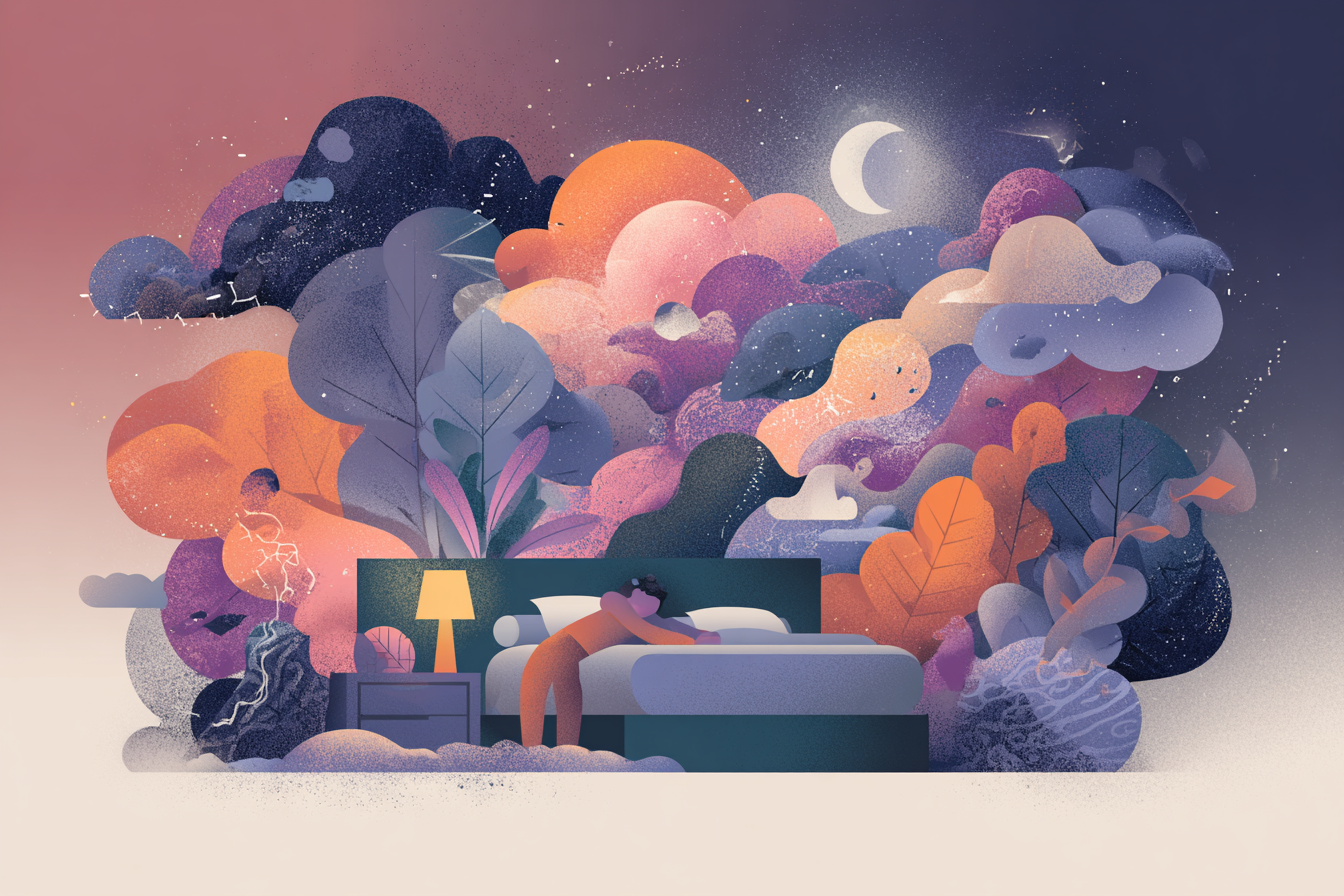

Somewhere around 2:47 AM, the mathematics of desperation sets in. If you fall asleep *right now*, you can still salvage four hours. Then three. Then two. You’ve done the breathing exercises, spritzed the lavender, downloaded the sleep app—and yet your brain treats the mattress like a conference room table where it’s suddenly planning to solve every problem you’ve ever had.
Here is the uncomfortable truth that sleep researchers want you to hear: most of us are trying to sleep with the same diligence we apply to cramming for exams. We treat rest as a collapse rather than a process, a switch we can flip at 11:00 PM after scrolling through blue light for hours. But sleep, according to decades of research from the Mayo Clinic to the National Heart, Lung, and Blood Institute (NHLBI), is less like a light switch and more like a plane landing. It requires a gradual descent, specific atmospheric conditions, and a runway cleared of debris.
The One Habit That Trumps All Others
If you only change one thing, make it this: go to bed and wake up at the exact same time every day, including weekends. Yes, including Sundays. This isn’t wellness-guru rigidity; it’s biological engineering.
Your circadian rhythm—that internal clock governing alertness and drowsiness—can only adjust at a rate of about one to two hours per day. When you sleep until noon on Saturday after a week of 6:00 AM alarms, you’re essentially giving yourself jet lag without leaving your time zone. The American Heart Association and CDC both emphasize that this “social jet lag” weakens the very mechanisms that allow you to fall asleep quickly during the week.
The goal is 7 to 9 hours for most adults, with a hard ceiling of 8 hours actually spent in bed if you tend to fall asleep quickly. More time in bed than that, and you risk creating a psychological battleground where you associate the mattress with wakefulness. But here is where the science recently evolved: a 2023 National Sleep Foundation consensus statement, cited by Harvard Health, suggests that *strategic* catch-up sleep on weekends may be beneficial after a week of chronic deprivation. The nuance matters—this is recovery for prior damage, not a license to rotate between exhaustion and hibernation every seven days. Consistency remains the non-negotiable foundation; the weekend reprieve is emergency maintenance, not architecture.
The Final Hour: Programming Your Nervous System for Shutdown
The sixty minutes before your head hits the pillow are not “free time.” They are the buffer zone where your body transitions from sympathetic (fight-or-flight) to parasympathetic (rest-and-digest) dominance. Harvard Health calls this the “wind-down ritual,” and it has specific exclusions: no screens, no work emails, no intense conversations, and no vigorous exercise.
Blue light from devices suppresses melatonin production, but the cognitive stimulation matters just as much. You’re training your brain to treat the bed as a workspace. Instead, the evidence points to deliberately boring activities: reading something unthrilling, light stretching, or a warm bath taken 1–2 hours before bed. (The bath works because upon exiting, your core body temperature drops, signaling sleepiness—another reason why the bedroom itself should be cool.)
Here is the paradox that sleep medicine understands better than wellness culture: trying harder to sleep makes it harder to sleep. The Mayo Clinic and NHLBI both prescribe a “20-minute rule”—if you haven’t fallen asleep within about twenty minutes of lying down, you must leave the bedroom. Don’t check your phone; don’t turn on bright lights. Sit in another room and do something mind-numbing in low light. Return only when you feel sleepy. This breaks the anxiety association that turns insomnia into a chronic loop.
Building the Sensory Void
Your bedroom should resemble a cave engineered by someone who understands thermodynamics. The precise temperature range recommended across sources—from Harvard Health to UC Davis—is startlingly specific: **65 to 68 degrees Fahrenheit** (18–20°C). Cooler rooms facilitate the natural drop in core body temperature required for sleep onset.
But temperature is only the beginning. The room must be dark—pitch dark. Blackout shades or an eye mask aren’t luxuries; they’re tools to prevent light from suppressing melatonin. Sound matters too. While total silence is ideal, white noise machines serve a specific function: masking the unpredictable sounds (traffic, neighbors, plumbing) that trigger micro-awakenings you won’t remember but that fragment your sleep architecture.
Crucially, as Mayo Clinic’s Dr. Virend Somers emphasizes, the bed itself should be reserved for only two activities: sleep and sex. Not spreadsheets. Not Netflix. Not reading thrillers. When you introduce work or entertainment into that space, you weaken the conditioned association between the mattress and unconsciousness. You’re essentially asking your brain to multitask in its most vulnerable state.
What You Owe the Day
Sleep hygiene doesn’t begin at 10:00 PM; it begins at 10:00 AM.
**Light:** Exposure to natural sunlight within fifteen minutes of waking acts as a “zeitgeber”—a time-giver that anchors your circadian rhythm, making evening sleepiness arrive on schedule.
**Movement:** Regular exercise dramatically improves sleep quality, but timing is contentious. Sources vary between avoiding vigorous activity within 2 hours (Harvard) versus 4 hours (Centre for Clinical Interventions) of bedtime. The explanation? Individual variation in cortisol response and core temperature regulation. If you’re sensitive, evening workouts may leave you wired; if you’re not, you may tolerate a 7:00 PM run. A two-week sleep diary is the only way to know your personal cutoff.
**Stimulants:** Caffeine’s half-life stretches up to eight hours, meaning a 2:00 PM latte can still be affecting you at 10:00 PM. Recommendations range from “after lunch” (conservative) to “4–6 hours before bed” (standard), but genetic variation in metabolism plays a huge role. Alcohol is sneakier—it may knock you out initially, but it fragments sleep later in the night, suppressing REM cycles. The advised window is 3 to 6 hours of avoidance before bed.
**Naps:** If you must nap, treat it like a surgical strike—less than 30 minutes, and absolutely before 3:00 PM. Anything longer or later begins to cannibalize your nighttime sleep drive.
The Slow Installation
Here is the implementation strategy that separates successful habit formation from abandoned New Year’s resolutions: do not attempt all of this at once. UC Davis Health, drawing from Cognitive Behavioral Therapy for Insomnia (CBT-I) principles, recommends targeting only **one or two new behaviors per week**.
As Dr. Jesse Koskey notes, “It’s better to do just one of these new behaviors every night than all of them every now and then.” Start with the circadian anchor—fix your wake time. Then, perhaps, install the screen curfew. Then optimize the temperature. Sleep is a skill built through repetition, not a perfect routine you fail at once and abandon.
When the Perfect Routine Isn’t Enough
All of this advice assumes you have a sleep-friendly brain in a sleep-friendly body. But approximately 40 million Americans have sleep disorders that hygiene cannot fix. If you’ve maintained rigorous sleep hygiene for 4–6 weeks and still experience persistent insomnia, loud snoring, gasping for air, or unrefreshing sleep, you may be dealing with sleep apnea, chronic insomnia, or restless leg syndrome—conditions requiring medical intervention, not just a better bedtime routine.
The “perfect” bedtime routine, then, is not a universal checklist but a personalized system built on non-negotiable principles: biological consistency, sensory optimization, and a respect for the gradual nature of sleep onset. It requires you to treat the transition into unconsciousness not as a collapse, but as the final movement of a daily symphony you began conducting the moment you woke up.